
Under financial pressure? The latest ASIC data shows turnarounds work – if you move early
More Australian companies are failing than at any time on record. ASIC’s data shows 14,722 companies entered external administration in 2024–25, up a third on the year before, with construction and hospitality hit hardest. The ATO is back to full enforcement – director penalty notices, statutory dem
More Australian companies are failing than at any time on record. ASIC’s data shows 14,722 companies entered external administration in 2024–25, up a third on the year before, with construction and hospitality hit hardest. The ATO is back to full enforcement – director penalty notices, statutory demands and winding-up applications are flowing again.
That is the bad news. The good news sits in two ASIC reports most business owners will never read: REP 810, ASIC’s review of the small business restructuring (SBR) regime, and REP 836, its first detailed review of voluntary administration (VA) and deeds of company arrangement (DOCAs). Together they show that when a struggling business acts early and prepares properly, formal restructuring saves businesses – and pays creditors far more than liquidation would.
What the numbers actually say
Small business restructuring is working
SBR lets an insolvent company with under $1 million in liabilities put a debt compromise to creditors while the directors stay in control of the business. Uptake has exploded – from 82 appointments in the regime’s first 18 months to around 3,000 a year now. ASIC’s review of 3,388 appointments found:
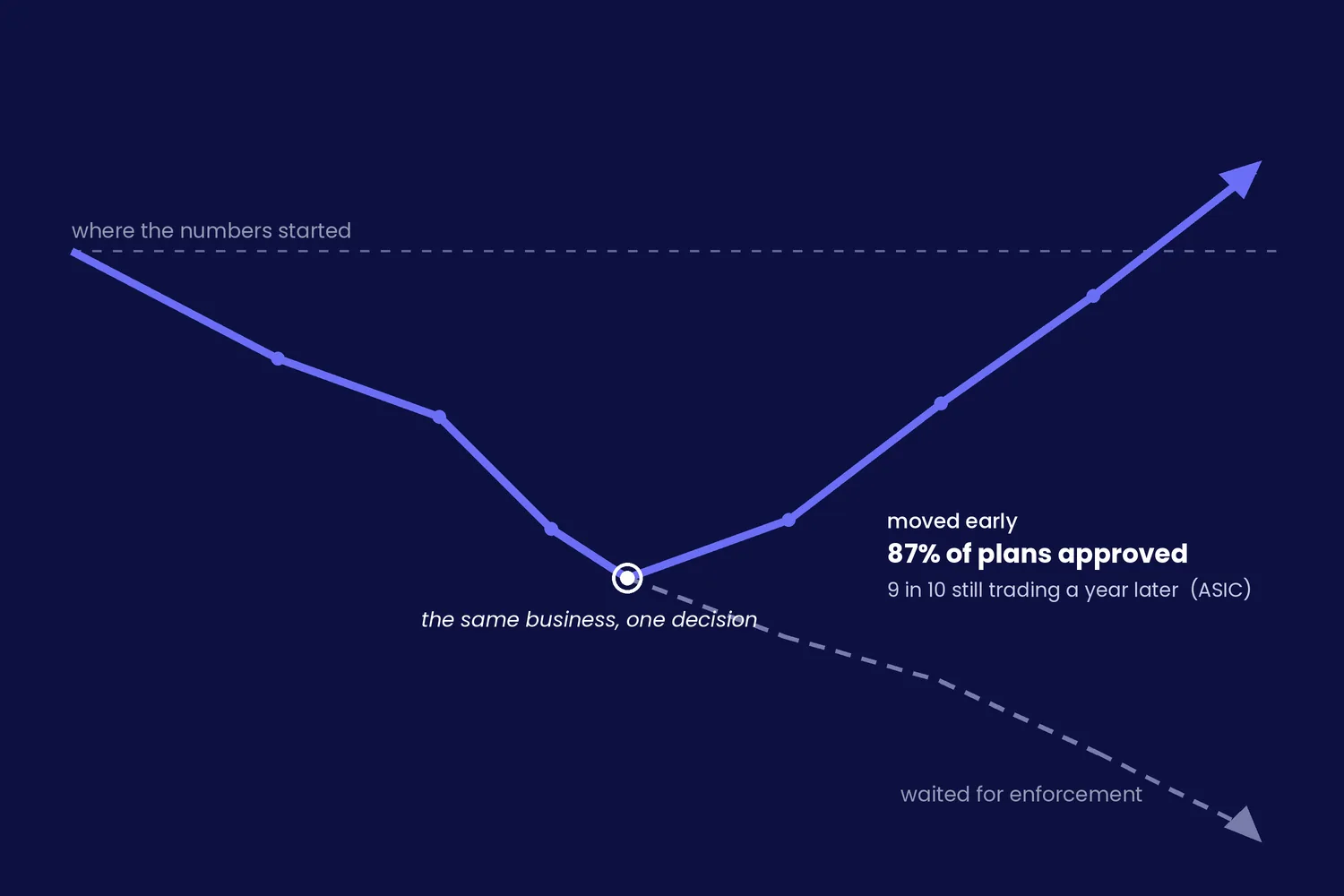
• 87% of restructuring plans put to creditors were approved, and 92% of finalised plans were fulfilled.
• Nine in ten companies that completed their plan were still registered a year later.
• Creditors received a median dividend of 20 cents in the dollar – with over $101 million returned to unsecured creditors, most of it to the ATO.
• The median total cost was about $22,000 – a fraction of the cost of most formal insolvency processes.
Voluntary administration still rescues bigger businesses
For companies too large or complex for SBR, voluntary administration remains the main rescue tool. An independent administrator takes control, creditors get a moratorium-protected breathing space, and a DOCA can compromise debt, keep the business trading or sell it as a going concern. ASIC’s review of 3,528 appointments over four years found:
• 44% of administrations ended in an approved DOCA – and where a deed was proposed, creditors accepted it 87% of the time.
• Almost half of all deeds saw the business continue trading, and around 90% of completed deeds paid a dividend, averaging 21 cents in the dollar. In most of these matters, the estimated return in a liquidation was nil.
• Size matters: nearly half of administrations with liabilities over $10 million reached a deed, against roughly 15% of the smallest. For small companies, SBR is usually the better-value pathway.
The catch: outcomes are decided before the appointment
Buried in ASIC’s data are two findings every director under pressure should sit with.
Timing. Where a winding-up application was already on foot, the chance of achieving a deed roughly halved. Those last-minute defensive appointments have quadrupled as ATO enforcement has ramped up. By the time a court application lands, cash and creditor goodwill are usually gone.
Funding. Deeds funded by hoped-for future trading profits failed at more than twice the rate of deeds with committed, up-front funding. A rescue built on optimism is a forecast, not a plan.
The foundations of any turnaround
Whether the answer ends up being an ATO payment arrangement, an SBR, a voluntary administration or simply a well-executed operational turnaround, the groundwork is the same:
-
**Keep tax lodgements up to date – even if you can’t pay.** Lodgement is a condition of entry to SBR, and lodging on time protects directors from automatic personal liability under lockdown director penalty notices. Unlodged returns take options off the table. -
**Pay superannuation.** Outstanding employee entitlements block SBR eligibility and expose directors personally. If there are arrears, quantify and deal with them first. -
**Engage with the ATO – don’t ignore it.** A realistic payment arrangement can buy time for a viable business. Ignoring demands invites the winding-up application that halves your restructuring prospects. -
**Review viability honestly.** Find the root cause – margin, pricing, overheads, a bad contract or bad debtor – and confirm there is a profitable core business once legacy debt is dealt with. If the cause isn’t fixed, the debt comes back. -
**Make the operational changes.** Exit loss-making work, reprice, cut overheads, chase debtors, renegotiate leases and supplier terms. Creditors back turnarounds they can see, not promises. -
**Line up funding – debt or equity – before you need it.** Director or shareholder contributions, refinancing, asset sales, working-capital finance or an outside investor. ASIC’s data is blunt: committed, front-loaded funding succeeds; “we’ll pay it from profits” mostly doesn’t. -
**Communicate clearly.** Keep financiers, key suppliers, landlords and staff informed. The data shows creditors consistently vote for credible, transparent proposals – even at modest returns – because certainty beats a speculative liquidation. -
**Get advice early.** Every number in both ASIC reports rewards the business that acted before enforcement started. The earlier the conversation, the more options exist – including options that avoid formal insolvency entirely.
A note for accountants
You see the warning signs first: growing ATO arrears, unpaid super, maxed-out related-party loans, suppliers tightening terms. A referral for restructuring advice is not a referral into liquidation – on ASIC’s numbers it is now, more often than not, the step that keeps a viable client trading. A confidential, no-obligation conversation costs nothing and preserves every option. Waiting usually costs the client the best ones.
Rapsey Griffiths advises directors, accountants and lawyers on turnaround, restructuring and insolvency. If you or a client are feeling the pressure, contact us for a confidential discussion of the options – the earlier, the better.
This article provides general information only, based on ASIC REP 810 (June 2025), REP 836 (July 2026) and ASIC insolvency statistics. It is not legal or financial advice. Every situation is different – seek advice on your specific circumstances.
Last updated 23 July 2026. This is general information, not advice for your situation.